The Joy Of Mediocrity

As usual, I was dazzled by the Olympics.  So this may sound strange, but I’ve been thinking about the joys of mediocrity lately.

I’ve competed in archery off and on for quite a few years, and my skills are to the Olympics what a tricycle is to a 1966 Corvette Stingray with a 427 big-block.  I’m only good enough to get an inkling of the tremendous physical and mental preparation necessary for Olympic-level archery.

The thing is, there’s such a small margin between an Olympic gold medal and last place, we don’t really get a sense of perspective.  When all the competitors are world-class, missing by a fraction of an inch or a few hundredths of a second looks like failure.  Just for giggles, the IOC should invite a few ordinary weekend warriors to compete in the qualifying rounds of the Olympics.  You know, like a pro-am.  Then we’d understand how amazing even the last-place Olympic finishers are, compared to the average joe.

So hats off to the Olympians… but I’m celebrating “average” this week.

Mediocrity lands me square in the middle of the pack.  Even though I’m worse than half the field, I’m still better than the other half.  Nobody hates me for being too good or despises me for failing.  And when I don’t excel, hey, I’m just doing my part to make those top guys look good.

Excellence takes a hell of a lot of time and effort and commitment.  Mediocrity isn’t nearly as much work.  I love variety, so it’s far more fun for me to do lots of things more or less competently than to practice one thing long enough to do it perfectly (which probably explains my mistake-ridden piano playing and Bob-Ross-style oil painting).

And best of all, the phenomenon of illusory superiority kicks in at some point, too.  (Oversimplified definition:  If you’re not very good at something, you tend to think you’re better at it than you actually are.)

I’m not going to analyze that theory too closely because it might damage my happy illusions about my own competence.  I’m just going to say that with mediocrity, I can relax and enjoy.  If I end up winning, great.  If not?  Well, no surprise.  I get to have fun either way.  Granted, it sucks to end up in last place, but what the hell, somebody’s gotta come in last.

I realize this attitude makes me sound like a lazy slacker.  Don’t get me wrong, I do my best and I’m always trying to improve.  But “my best” means I work out 4 to 6 hours a week, not 4 to 6 hours a day.  I like having a life.

I have tremendous respect for the Olympic athletes.  Citius Altius Fortius is an admirable motto.  But ya know what?  “Good enough” is good enough for me.

Now, who wants to join me while I suck back a cold one and watch TSN?
The Great Motorcycle Debate

*F-BOMB ALERT* – CONTAINS (more) COARSE LANGUAGE (than usual)

Spring is finally around the corner, and a middle-aged woman’s fancy turns lightly to thoughts of… motorcycles.  In honour of the season, I pose you the following question:  cruiser or crotch-rocket?

I’m a cruiser fan.  I’ve got some old wrist and knee injuries that get aggravated by the weight-forward position on a crotch-rocket, and anyway, I’m a traditionalist.  I like the kicked-back coolness of a cruiser.

Here’s the considered opinion of a couple of the characters in my second book, The Spy Is Cast:

*****

Germain and Hellhound put on their riding leathers, and we all trooped out of the hot RV into the cooler outside air.  Germain swung astride his Yamaha, and Hellhound grimaced.

“Shit.  Can’t believe I’m gonna hafta ride on the back of this piece a’ Jap crap.  Lucky it’s gettin’ dark so nobody’ll see me.  Why don’t ya get a real bike?”

“It’s better than that bone-rattling piece of shit you call a Harley,” Germain retorted good-naturedly.  “They’ve been making bikes for how long, and they still can’t make one with a decent muffler?”

Hellhound perched precariously on the back, struggling to hoist his boots up onto the passenger pegs.  “Why the hell would ya wanna ride one a’ these goddam crotch rockets anyhow?” he groused as he groped behind him for handholds.  “Ya like bustin’ your fuckin’ nuts on the tank?  Maybe you ain’t usin’ your junk anymore, but I still wanna keep mine in workin’ order.”

“Don’t they make a cute couple?” I observed loudly to Kane.

“Hey, Germain,” Kane called.  “That’s got to be the ugliest girlfriend I’ve ever seen!”

Hellhound flipped him a stiff middle finger as they pulled away, and we laughed while they rode out of sight.

* * *

So which do you like better – cruisers or crotch rockets?

More Beaver!

A couple of weeks ago, one of our senators caused a kerfuffle when she took verbal potshots at our national animal, the beaver.  Calling it a “dentally defective rat” and a “toothy tyrant”, she suggested that we should change our national animal to the “noble” and much more photogenic polar bear.  Righteous indignation and off-colour jokes abounded.

According to the online poll at CBC, 78.54% of respondents thought the beaver should stay.  Comments sections were overwhelmed by thousands of responses.  Most of the male writers stated a particular fondness for beavers, though many accidentally omitted the ‘s’.  A mere oversight, I’m sure.  Female respondents in general tended to exhort the good senator to leave their beavers alone.

In keeping with the typical ugliness of celebrity confrontations, the love lives of the contenders were brought into question, too.  Many observed that polar bears will pretty much screw anything that moves, while beavers mate for life, thereby cementing the beaver’s reputation as a morally superior mammal.  (No word on the senator’s love life at this time.)

To add to the mud-flinging, photos worthy of the most sordid tabloids were posted, showing a frowsy beaver with a deranged expression, contrasted with a soft-focus photo of a snowy-white, perfectly-groomed polar bear.  In retaliation, the polar bear’s weight problem was identified and cruelly ridiculed.

Almost as cruelly ridiculed was the senator herself.  The general consensus was that we should keep the beaver and ditch the senate.

In other news, I noticed an article about farmers hunting beavers to save their land from the destructive flooding caused by dams.  No eyebrows were raised over this article, though.  It’s not exactly news that much time, energy, and money is expended in the hunt for beaver.  Or, um… beavers.

P.S.  I’m still with my step-mom while she undergoes chemo this week, so I may be slow in responding to comments, and I might not make it around to comment on my favourite blogs.  I’m still thinking of you, though.  Thanks for visiting!

PANIC!! …Nah.

It’s funny how the bloggers I follow seem to read each other’s minds.  This past week, there have been all kinds of posts about stress, panic, and overwhelm.  So what the hell, I’ll get in on it, too.

Panic is an interesting critter.  It starts out as, “Oh, crap, I forgot the candles for hubby’s birthday cake”, and instantly morphs into, “Oh-my-God-I’m-such-a-loser-my-husband-will-divorce-me-my-friends-will-hate-me-I’ll-end-up-dying-broken-and-alone-in-a-rat-infested-cardboard-box-under-a-bridge”.

Whoa, say what?  That’s good stuff.  If I could pour that into an engine, I could blow the doors off some top-fuel dragsters.  Zero to insanity in under a second.

Don’t get me wrong, I’m not joking about real panic attacks*.  But our everyday “panic situations”?  Yeah, I’m joking about them.  They’re an overrated pastime.

This was inspired by the “Everybody PANIC!” post over at Visiting Reality. Thanks, Linda!

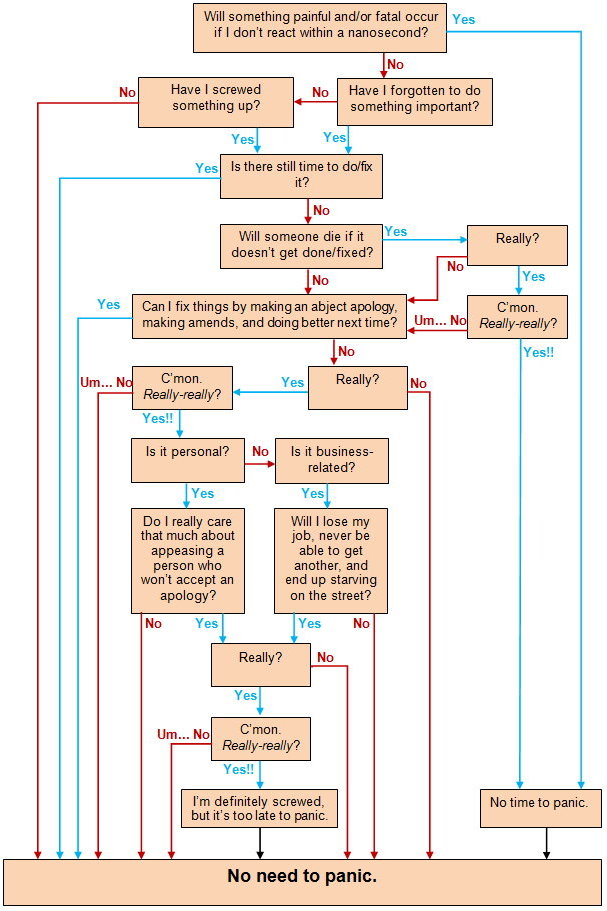
And since Charles Gulotta over at Mostly Bright Ideas reminded me he wants another flow chart (and he just did a stressed-out post, too)… voilà:  here’s another scary glimpse into the inner workings of my brain.

Charles, this one’s for you.

Is It Time To Panic Yet?

Panic Flow Chart

*If you’ve ever had a real panic attack, you know that on a 0 – 10 Funny Scale, panic attacks are about a -50.  A word of advice from someone who’s been there:  If you have panic attacks, find yourself a medical professional who specializes in cognitive therapy.  You’re not crazy, you’re not a coward, and you’re not weak.  Your brain just took a wrong turn down the logic-path and ended up in the “Oh-shit-I’m-about-to-be-eaten-by-something-big-with-sharp-teeth” parking lot.  Trouble is, it gets in the habit of taking that shortcut, and the longer you let it do that, the longer it takes to break the habit.  And yes, it is possible to stop having panic attacks, it just takes a while.  Go take care of it.  Soonest.  Not kidding.  Okay, I’m getting off my soapbox now.

That Ain’t Funny

I recently followed a link on one of the blogs I read regularly.  The blogger is normally a very funny guy.  The link was to a site containing an extensive catalogue of sex acts (which was clearly stated in his post – no surprises there).  I’m hoping the site was meant to be funny.

As a general rule, I can laugh at just about anything, including accidental flashers, farts in the car, and naked men dangling (snicker) outside my hotel window.  I clicked through to the site knowing that it would contain adult content, and I fully expected that I’d find some things that were not, um, up my alley.

But a large percentage of the acts included punching and/or kicking a female partner, breaking bones, non-consensual acts (which we old-fashioned types still refer to as “rape”), and murder.

Yeah, really.  Gang-rape her and chuck her in the dumpster when you’re done.  Or smash her head against the wall until her brains smear all over it.  Their words, not mine.  “Bitch” and “whore” were the words of choice when referring to a female partner.  And apparently one method of birth control is to smash her pelvis with a hammer.  “By the time she’s finished at the hospital, she probably won’t get pregnant anyway.”

Some of the acts came with the endorsement, “This one’s really fun”.  Like this one:  Punch her in the eye and kick her in the shin hard enough to break it.  Then she’ll look like a pirate with an eye patch and a peg-leg.

Wait, why am I not laughing?

I didn’t read the entire site.  Maybe it got funnier.  Or maybe I took a wrong turn somewhere and missed the humour.

I didn’t know how to react.  I expected ripe language and adult content.  But for me, this site stepped over the line.  Hell, who am I kidding?  This site launched itself so far over the line, it achieved low-earth orbit.

I went back to the blog again and read the comments, wondering if anyone had reacted negatively.  No.  Comments from both male and female readers, none of whom apparently had any problem with the link.

I don’t know what to do.

I know that my blog may offend some people.  I can be pretty vulgar.  I assume that people who don’t like my style will simply go away and never come back.  Nobody’s forcing them to read this.

So now that I find myself offended by a site, is it “my fault” for reading it?  It is hypocritical to comment on his blog about it?  Should I just shut up and go away?

Or should I go whole-hog and report the site as hate-mongering and inciting criminal acts of violence against women?  I’m sure the site owner(s) would insist it’s meant to be funny and I’m clearly some tight-assed do-gooder who can’t take a joke.  Free speech and all.  But where do you draw the line?

What would you do?

How Do I “Like” Thee?

Last week’s post was based on some interesting conversations about “appreciating” people besides one’s significant other.  That got me thinking, which is usually dangerous.

A few days ago, I was at the gym, surreptitiously ogling the magnificent upper body development of a couple of half-naked guys.  And no, I’m not going to tell you where I work out.  That’s my eye-candy.  I don’t share well.

The point is, I enjoyed looking, and I wasn’t the least bit interested in doing anything else.  But it made me wonder:  would they want to know I was appreciating them?

If the situation was reversed, I’d like to know.  Then again, I’m at the time of my life when being appreciated for anything pretty much makes my day.  (You:  “That’s an unusually-shaped freckle.”  Me:  “Thank you!”  *beams*)

I don’t want to go back to the days when we lived with the fact that we’d get groped and leered at and propositioned wherever we went.  I’m not talking about appreciating people to the point where you sidle up to them and lovingly run your sweaty tongue down their neck.  I’m pretty sure that kind of thing needs to be restricted to your significant other.  Preferably in private.  ‘Cause, y’know, the rest of us don’t really want to see that.

But how about a no-harm, no-foul code word that just means “I appreciate you”?  The equivalent of a “Like” button, minus the contact with sweaty anatomical bits.

I’m not just talking about appreciating members of the opposite sex, either.  I’m talking about appreciating anyone you find attractive, physically or otherwise.  Personally, when I notice an attractive person of any age or gender, my brain says, “Nice!”

I realize that this is not particularly eloquent, but it’s versatile.  It can be applied with equal appropriateness to the old lady who smiles at me with joy written in every wrinkle, and the hot hunk in his well-filled jeans.  Though in the latter case, I find that extra vowels and/or syllables may get added.  “Niiiiiice!”  And sometimes, “Ni-yi-yi-yi-yice!!”  But that might just be me. And I usually remember to use my inside voice.

How would it feel if you were out getting groceries one day, and a total stranger walked up to you, smiled, and said “Like!”  And then walked away.  No innuendos, no pressure, no lingering drool.  Just simple, innocent appreciation.

True, you wouldn’t know whether you were being appreciated for your face, your shoes, your kindness in allowing them to precede you through the lineup, or the fact that they’ve never before seen a person who’s capable of causing a landslide of produce by removing a single apple.  But it wouldn’t matter.  Just like Facebook, you don’t know exactly why you’re being “Liked”, but it gives you a warm fuzzy feeling anyway.

I realize this is a ridiculously naive and possibly dangerous idea.  I know that some people wouldn’t appreciate being “Liked”, no matter how innocent it might be.  And I know there are far too many people out there with no sense of appropriateness or boundaries, so it couldn’t possibly work.

But… I kinda wish it could.

What do you think?  Would you like to be “Liked”?

Better Left Unanalyzed

I’ve just been reading a fascinating dialogue between Charles Gulotta at Mostly Bright Ideas (Better Left Unsaid, Part 1), and Priya at Partial View (Better Left Unsaid, Part 2).  Go and read both posts, along with all the comments.  It’s well worth it.  I’ll wait.

Now that you’re back, here’s my two cents worth. 

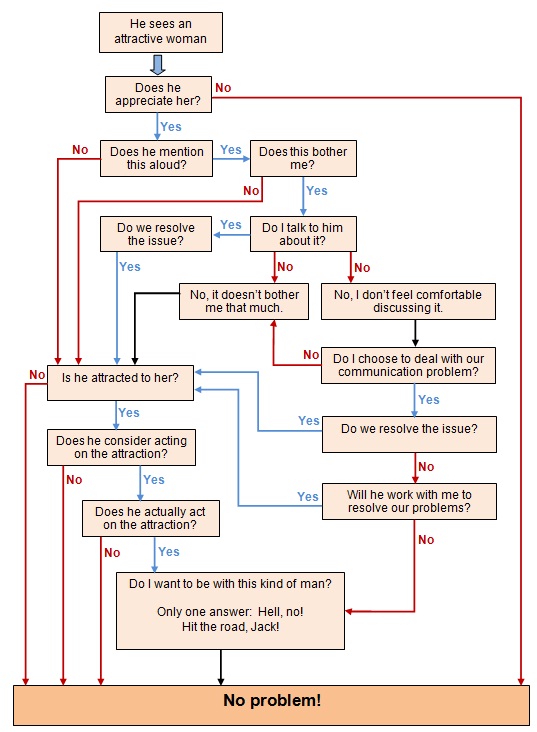
I was intrigued by the fact that both Priya and Charles seem to use the words “attraction” and “appreciation” interchangeably.  I think there’s a fundamental difference between the two.  Appreciation is window-shopping.  It’s harmless, enjoyable, and free.  Attraction is walking into the store to buy.  Attraction can cost you big. 

It doesn’t bother me a bit if my husband appreciates, or is attracted to, another woman, celebrity or otherwise.  My husband and I are both geeks, so our minds work a little differently than the rest of the world. 

Geeks believe that all issues can be resolved using a flowchart.  Look below for my take on the whole “Better Left Unsaid” discussion, if you dare.

WARNING:  Viewer discretion is advised.  This flowchart reveals the horrifying inner workings of the geek mind.  May cause warping, distension, or catastrophic failure of normal brains. 

Don’t say I didn’t warn you.

Too Girly For Comfort

Roni Loren just posted “Battling the Romance Novel Stigma”.  It made me uncomfortable.

It’s best to read the whole thing, but if you’re short on time, here are the parts that rattled my comfort cage:

“…women often are embarrassed to admit it’s a romance or apologize in some way when they admit it.”

“Why are we made to feel that if we’re reading romance we’re something less than – less classy, less educated, less evolved? Or even worse, that something must be wrong with us because we can’t find a real man and instead look for them in books.”

I just hate the fact that those attitudes are real.  I tried about six times to write a comment on her blog, and each time I flailed. 

I’m not a romance reader.  I read romance novels for about six months when I was a young teenager.  I grew up on a farm in the back of beyond, so the tiny library in a town twenty miles away was my only source.  Let’s just say that their selection was limited.  After a couple dozen, even my thirteen-year-old mind identified the formula.  I got bored.  End of reading romance. 

Not to mention the fact that there was no sex in them whatsoever.  Boring.  I started reading fine literature like Stand On It:  A Novel by Stroker Ace instead.  Which probably explains a lot.

Back to the point.  I’ve always been a tomboy.  If I have a choice between listening to somebody discuss relationships or cars, I’ll choose cars every time.  I assumed that my discomfort with the romance genre was due to the fact that I’m not very girly in the first place.

But it bothers the hell out of me to think that women who do enjoy reading romance would feel embarrassed to admit it. 

Why should they?

And yet…  I was reading a novel at the airport.  It was an urban fantasy, but the cover art showed a couple locked in a passionate embrace.  And yeah, I kinda hid the cover.

Because… because… here’s where I start to struggle.  Why would I be embarrassed?  Because somebody might think I’m reading a romance.  Okay, so what the hell is so bad about that?

Well, somebody might think I’m girly.

Which is bad, why?

Well…

Um.

I’m a child of the sixties.  Back then, women were fighting for equality.  A lot of women tried to act more like men in an effort to prove that we deserve equal respect.  Maybe there’s some of that in there.  Men don’t read romance novels.  Ergo, reading romance novels is a sign of weakness.

Which, of course, is pure bullshit.

But it may be part of our collective psyche. 

Why should we apologize for our gender?  “Girly” is used as an epithet.  You don’t see guys sheepishly hiding the covers of their books and mumbling, “Oh, I’m just reading some of that silly manly stuff.”

Now, I’m really wondering. 

Is there a particular demographic that’s embarrassed about reading romance?  Maybe my generation is still dealing with the last of those old attitudes.  But what about our teenagers and twenty-somethings?  Are they embarrassed to be girly?  If they are, we as a society are doing something very wrong.

I guess I’m upset because I was getting complacent.  We’ve come so far, both legally and socially, in my lifetime.  I really thought we were getting there. 

Somebody please help me out here.  Is it only my generation that’s embarrassed to be girly (or only me)?  Is it a sign that we’ve become too complacent and we’re actually losing ground on equality?  Does it just mean that we’re not quite there yet?

Or am I making too much of this?

99-Cent Train Wreck

Update May 30/11:  I just found an excellent post, “The Pricing of eBooks and Perceived Value“, on Bob Mayer’s blog.  Seems I missed two critical points in my post: 

1) There’s a place for 99-cent e-books as a method of diminishing risk for potential buyers.  The important point here is that not all your books get priced at 99 cents, and they don’t necessarily stay priced at 99 cents.

2) I didn’t mention the sliding royalty scale that’s applied to e-books.  Bob does the math in his post.  When I advocated jacking up the price of e-books, I was thinking in the range of $2.99 to $8.99.  Bob’s post explains why that range would be okay, but anything over $9.99 doesn’t currently work to the author’s advantage.

Here’s my original post:

**************************

I’ve seen a lot of discussion on blogs lately about the idea of selling electronic books for 99 cents.

I’m a business owner in real life.  I’ve spent the better part of the last four years reading up on marketing, consumer behaviour, and pricing.

This is like watching a trainload of people hurtling towards the proverbial busted trestle sagging into the proverbial canyon.

I only hope a few passengers will notice my frantic gesticulations.

Oh, look, charades!  Two words, sounds like… head… no… brain.  Neck.

Brain neck?

Yeah, that’s what I said.  Train wreck.

Bail out now, folks, ‘cause if you stay on that train you’re gonna end up with a locomotive parked on your chest.  At the bottom of the canyon.  Submerged in a raging river.  Surrounded by hostile…  Well, you get the picture.

On my business website, I priced my computer training workbooks exactly the same for the paper and electronic versions.  Nobody ever quibbles.  They buy electronic, because they can have it immediately.  They rarely buy hard copies.

Your work has value.  When people buy your book, they’re not paying for the way it’s delivered.  Whether it’s fiction or non-fiction, they’re paying for the privilege of transferring a little bit of your brain into theirs.

That value isn’t diminished just because nobody killed a tree.  Spin that another way, and the electronic version is actually more valuable because the customer can have it instantly.

As soon as we begin to discount electronic books, we’re entering a commodity pricing system.  Simply put?  Some cheap bastard will always offer it for less.  And everybody loses.

This train ride is a one-way trip.  Once we let consumers believe that electronic books are “less valuable”, they’ll take it as a personal affront if we try to jack up the price later.  We’re in the early stages of this game.  Now’s the time to educate our customers about what they’re really getting.

Some people argue that lower pricing decreases the perceived risk for the buyer.  “I’ll buy it because I can afford 99 cents.  If it’s crap, I haven’t lost much.”

True.  But what’s the customer really thinking?  “This might be crap.”

Gee, that’s the reaction I’m looking for when somebody considers my book.  Not.

There are better ways to reduce perceived risk without diminishing value.  Let ‘em see the first chapter.  If it’s crap, I won’t sell any books.  But, arguably, if it’s crap, I shouldn’t sell any books.

When people buy something expensive, they value the item more.

Pens come to mind. Cheap pens cost about thirteen cents apiece if you buy a box of fifteen.  Or I can buy one fancy pen for upwards of thirty dollars.  A single refill for it costs six or seven bucks.

Why the hell would I buy one pen when I could spend the same amount of money and get enough pens to last me the rest of my friggin’ life?  When they look at my signature, nobody can tell what kind of pen I used.

But fancy pens still sell.

Why?  Somebody sold the customer on the look of the pen, the feel of the pen, the quality of the writing experience, the status of owning a pen that murmurs in a well-bred voice, “I am worthy of respect because my pen cost more than your shoes.”

That’s differentiation.  It’s a “better” pen.

As writers, our opportunities for differentiation are somewhat limited.  As long as the cover art is good and the title looks interesting, there’s no way to tell whether the book inside will whisk you to the pinnacles of literary ecstasy or make you recoil at the steaming heap concealed within its pages.

But ya know what?  If I pay six bucks for it, I’m gonna expect a little more ecstasy.  And if it delivers, I’m gonna go back and get me some more.

Whether I sell one thirty-dollar pen or three hundred cheap pens, it’s the same amount of money in my pocket at the end of the day.

Except that tomorrow, I have to go out and find more customers.  Three hundred is a lot.

We can’t stop people from pricing their books at 99 cents, short of creating a self-policing professional association.  I’ll stop laughing now.  The phrase “herding cats” comes to mind.

But maybe that’s a good thing.  It gives us an opportunity for differentiation.  I say jack up the price of those electronic books so people understand and expect the value they’re getting.

What do you think?

Hello, World

When a computer geek writes his/her very first program, it usually generates the following text: “Hello, World.”

Well, I’m a geek.  Go figure.

I’ve resisted blogging for some time now, but peer pressure is a terrible thing. I’ve lurked on several blogs for a while. Kristen Lamb  has never heard of me, but her RSS feeds keep nagging me to create a platform.

And I keep seeing flash fiction challenges.  That’s why I started this blog.  I want to play, too.

So here goes…